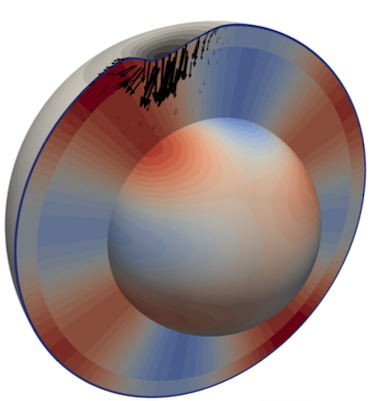
Glacial isostatic adjustment (GIA) describes the viscoelastic response of the solid Earth to the loading and unloading of ice sheets over glacial cycles. It is a critical process for understanding past and present sea-level change, interpreting geodetic observations (such as GPS uplift rates and gravity field changes from GRACE), and projecting future sea-level rise in a warming climate.
I am developing forward and adjoint models for GIA within G-ADOPT, treating the Earth as a viscoelastic body governed by a compressible or incompressible Maxwell rheology. The adjoint framework enables us to invert for poorly known quantities like mantle viscosity structure and ice sheet history.
A particular focus of mine is understanding GIA during the mid-Pliocene warm period — the last time CO$_2$ levels were comparable to today — where dynamic topography effects complicate the interpretation of the sea-level record. Disentangling the contributions of ice mass change, mantle flow, and viscoelastic rebound to the observed shoreline markers is essential for using the Pliocene as an analogue for future sea-level rise. This work is supported by my ARC DECRA Fellowship.